Most people who try to learn French quit within three months. They download an app, grind through flashcards, memorize verb conjugations — and still can't understand a single sentence a native speaker says.
The problem isn't effort. It's the method. For over 40 years, research in second-language acquisition has pointed to one consistent finding: people acquire languages by understanding messages, not by memorizing rules. Krashen called it the Input Hypothesis. The teaching world calls it comprehensible input.
This piece is the science in depth. If you want the practical, French-specific overview first — what it is, how to start from zero, how many hours it takes, and where to find input — start with the complete guide to French comprehensible input.
Learning and acquiring are not the same thing
Krashen drew a sharp line between two processes most people treat as one.
Learning is conscious
You study a grammar table, memorize that je suis means “I am,” drill endings until they stick. It lives in your head as explicit rules you can recite on command.
Acquisition is subconscious
You understand a message and your brain absorbs the patterns on its own. You can't point to the moment it happened. One day you hear elle est contente and you just understand it.
Fluency comes from acquisition, not learning.
Conscious rules are only useful as a last-resort editor; they can't generate speech in real time. This is why you can ace a grammar exam and still freeze when a French person speaks to you. The exam measures what you've learned. The conversation demands what you've acquired.
Input works when it's mostly clear, with a small stretch
Not all exposure counts — the message has to be one you can actually understand.
A child watching French TV without understanding anything won't acquire French — researchers documented exactly this with Dutch children whose only German came from television. The input has to be comprehensible.
Grammar-first learning stalls most people
The assumption that learned rules convert into fluency doesn't hold up.
Traditional teaching puts grammar at the center: learn the rules, then apply them. Krashen's research suggests the conversion never really happens.
At the other end, Krashen found “underusers” who picked up a language through exposure and spoke fluently despite performing poorly on grammar exams — judging correctness by feel, not by rule. Across dozens of cases, grammar knowledge and communicative ability barely correlated.
Stress quietly switches acquisition off
Understanding the message is necessary — but it isn't enough on its own.
Krashen proposed that your emotional state acts as a filter on incoming language. When anxiety is high — you feel judged, afraid of mistakes — the filter goes up. The input reaches your ears but never reaches the part of your brain that acquires language. Being put on the spot or corrected in front of peers does exactly this.
Acquisition happens naturally when you're relaxed and absorbed in content you care about.
What it looks like when it actually works
Two classrooms that rebuilt themselves around understanding, not rules.
When Robert Patrick switched his Latin classroom to comprehensible input, he spoke Latin from day one — gestures, images, simplified speech, no translation, no grammar tables. Students read stories at their level and built understanding through repeated, meaningful exposure. They no longer needed to review at the start of each semester, because acquisition sticks in a way memorized rules don't.
For Spanish, Adriana Ramirez built a whole curriculum on storytelling — extended, absurd, engaging stories written with limited high-frequency vocabulary and heavy repetition. A boy travels from Egypt to India looking for blue cats; a snake and a mouse trade Spanish for running shoes. The vocabulary stuck because it lived inside a narrative students wanted to follow.
How The French Corner is built on this research
Every video on the platform is designed around these principles.
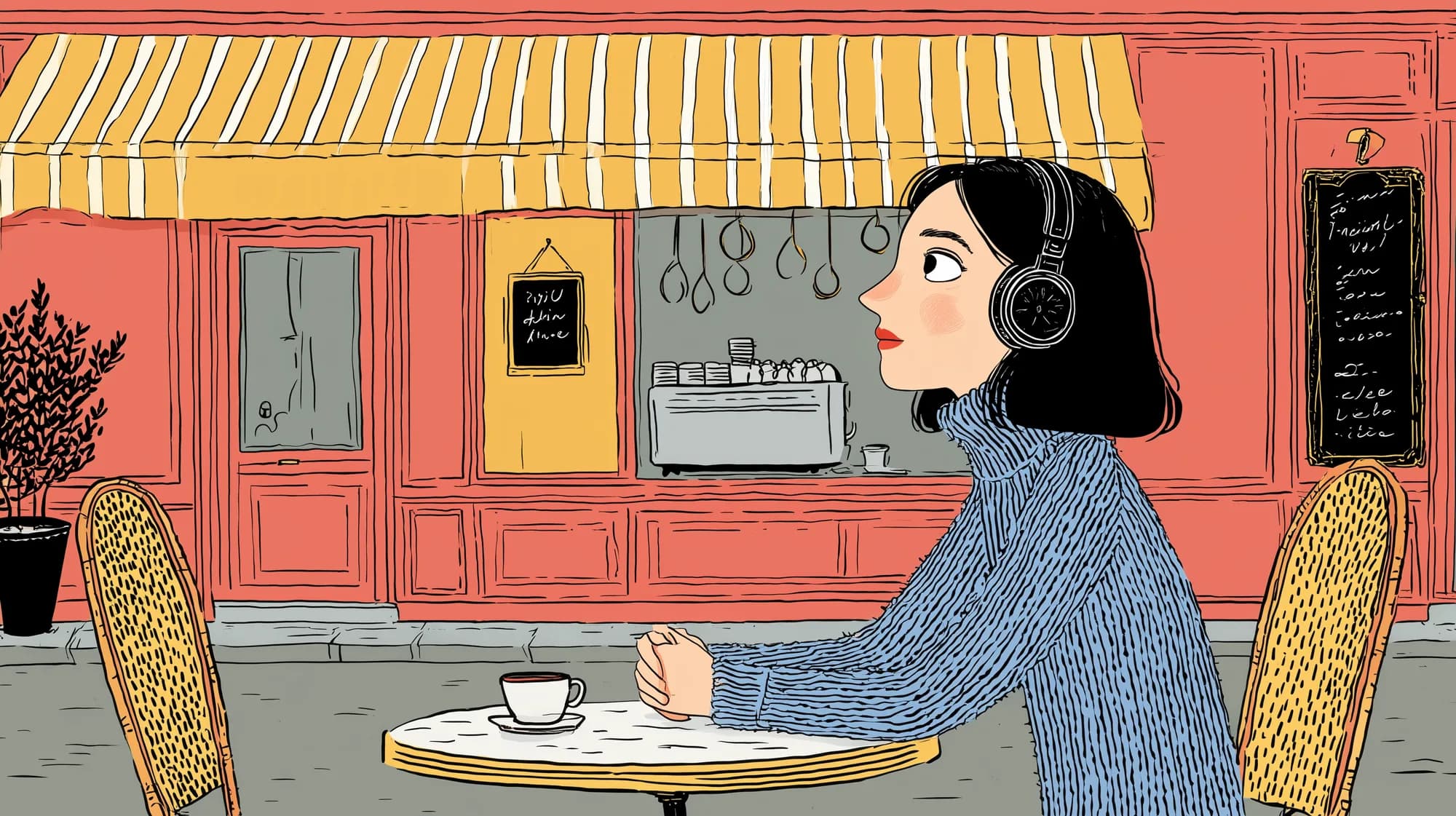
Each scene is a tiny world — a café terrace, a metro station, a bakery — and the illustrations do 90% of the work. When you hear l'homme lit un journal and see a man reading a newspaper, you don't need a translation. You understood the message. That's i+1 in action.
The speech is slow, clear, and deliberately repetitive; words recur across scenes so you meet them in new contexts. No grammar explanations, no quizzes, no pressure to produce. There's no teacher calling on you and no wrong answers, so the affective filter stays low — and each video tells a small story you want to follow.
The research says this is how languages are acquired. Not through study. Through understanding.
Start with one video
The fastest way to feel what acquisition is like is to stop studying for ten minutes.
Pick any free video on the platform. Watch it once. Don't try to catch every word — focus on the pictures, listen to the voice, and notice how much you understand without being told what anything means. That understanding you felt? That's acquisition happening.
References
- Krashen, S. (1981). Second Language Acquisition and Second Language Learning. Pergamon Press.
- Krashen, S. (1982). Principles and Practice in Second Language Acquisition. Pergamon.
- Krashen, S. (2013). The Compelling (and not just interesting) Input Hypothesis.
- Patrick, R. (2019). “Comprehensible Input and Krashen's Theory.” The Journal of Classics Teaching, 20(39), 37–44.
- Loschky, L. (1994). “Comprehensible Input and Second Language Acquisition.” Studies in Second Language Acquisition, 16, 303–323.
- Polat, N. (2016). L2 Learning, Teaching and Assessment: A Comprehensible Input Perspective. Multilingual Matters.
- Ramirez, A. (2021). Learning Spanish with Comprehensible Input through Storytelling. First Choice Books.